
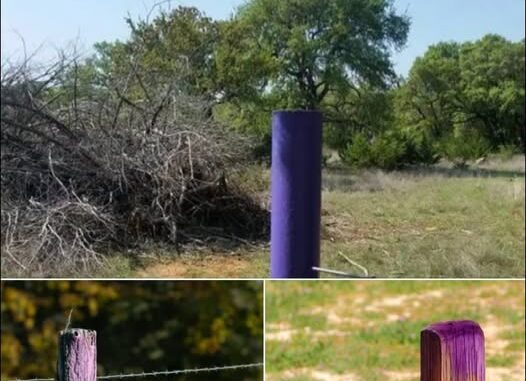
If you’re walking along a rural road, hiking near private land, or exploring a wooded area, you might occasionally notice something unusual: a fence post or tree marked with purple paint.
At first, it may look like an unusual decorating choice or simply a way for a property owner to add color to an otherwise ordinary fence.
In some parts of the United States, however, purple paint can have a much more important meaning.
It may be used to indicate private property and a warning against trespassing.
The important detail is that purple paint laws vary by state. A purple marking does not automatically carry the same legal meaning everywhere, so people should always pay attention to signs and local regulations.
Why Do Property Owners Use Purple Paint?
Traditional “No Trespassing” signs have been used for generations, but property owners in rural areas may have large boundaries that are difficult to mark with signs alone.
Signs can become damaged, fade in harsh weather, or require replacement. Paint can provide another way to make a property boundary noticeable.
Purple is particularly useful because it stands out against common outdoor backgrounds such as grass, soil, trees, and wooden fences.
Over time, several states have established laws allowing specific purple markings to serve as a notice that entry onto the property is not permitted.
Arkansas was an early adopter of this approach, and similar laws have since appeared in other states.
However, the exact requirements and legal effect depend on the state.
Does Every Purple Fence Mean “No Trespassing”?
Not necessarily.
This is one of the most important points to understand.
Purple paint is not a universal nationwide symbol with identical legal meaning in every location.
Some states recognize properly applied purple paint as legal notice of a property boundary or no-trespassing restriction. Other states may have different requirements or may not give the paint the same legal status.
A purple fence could also simply be painted purple because the property owner likes the color.
Therefore, if you’re unsure whether land is private, don’t assume that a purple marking alone tells the entire story. Look for posted signs, gates, fencing, trail information, or other instructions, and respect clearly marked private property.
How Purple Paint Laws Can Work
Where purple-paint statutes apply, the law may specify exactly how the markings must be made.
Requirements can include details such as:
- The color that must be used
- The size of the painted marking
- How high it should be placed
- How far apart markings should appear
- Whether paint can be placed on fences, posts, or trees
- Whether additional signs are required
These details are important because a random purple spot on a fence isn’t necessarily a legally recognized property notice.
The rules can also differ considerably between states.
For that reason, property owners should check the current laws in their own state before relying on purple paint as their primary property warning.
Why the Color Purple?
Purple is an effective visual marker largely because it is unusual in natural environments.
A brown fence surrounded by trees can easily blend into the landscape.
A bright purple stripe is much easier to notice.
The unusual color also helps distinguish the marking from ordinary construction marks, weathering, or natural features.
Rather than depending on someone to read a lengthy sign, a clearly visible color marking can provide an immediate visual warning.
That doesn’t mean purple has the same official meaning everywhere, but where state law recognizes it, the color provides a simple way of communicating that a property boundary should be respected.
Where Might You See Purple Markings?
Purple markings are most likely to attract attention in areas with large parcels of private land.
You might encounter them near:
- Rural properties
- Farms and ranches
- Wooded land
- Private hunting areas
- Fenced fields
- Large residential properties
- Trails crossing or approaching private land
In some states, markings may also be placed directly on trees rather than fences.
If you’re walking through a wooded area and notice regularly spaced purple markings on trees, don’t assume they’re decorations. They may indicate a property boundary.
What Should Hikers and Visitors Do?
If you’re exploring an unfamiliar area, the safest approach is simple: respect property boundaries and posted instructions.
Don’t cross a fence simply because there isn’t a conventional “No Trespassing” sign.
Likewise, don’t assume that an open gate means you’re automatically allowed to enter.
If a trail appears to continue onto private property, check the trail’s official information or look for signs explaining where public access ends.
When in doubt, stay on established public paths and avoid entering land that appears to be privately owned.
Purple Paint Isn’t a Substitute for Knowing Local Laws
Because purple-paint laws differ across the country, general information found online should not be treated as a complete guide to the law in a particular state.
For property owners, the best approach is to verify the current state requirements before using painted markings as a legal notice.
For visitors, the simplest rule is even easier: if an area appears to be private or is clearly marked as off-limits, don’t enter without permission.
The Takeaway
The next time you see a purple stripe on a fence or tree while traveling through a rural area, don’t automatically dismiss it as an unusual paint choice.
In certain states, properly applied purple markings can be an official way of communicating that private property should not be entered.
But because laws differ by location, purple paint does not have one universal meaning throughout the United States.
So if you’re hiking, driving through the countryside, or exploring an unfamiliar area, pay attention to fences, signs, trail markers, and painted boundaries.
Sometimes a small splash of purple is more than decoration.
It may be a quiet reminder to respect the property boundary and keep moving.
Leave a Reply