
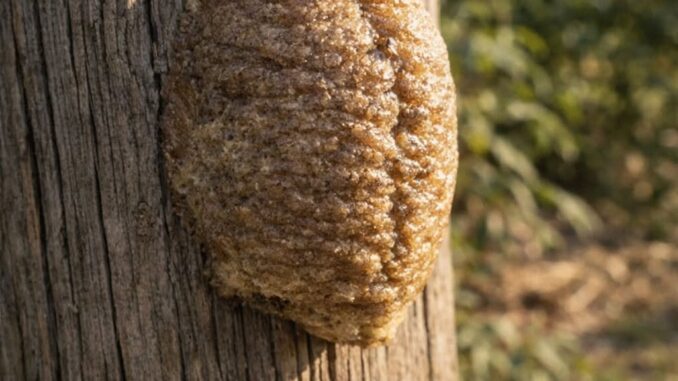
Spotting an unfamiliar object in your yard can be surprising, especially when it seems to appear overnight. If you’ve noticed a small, tan or brown foam-like mass attached to a fence, tree branch, shrub, or even outdoor furniture, you might wonder whether it’s something to worry about.
Fortunately, in many cases, the answer is no.
That unusual-looking structure is often a praying mantis egg case, also known as an ootheca. While its appearance may seem odd, it is a natural part of the mantis life cycle and can actually be a welcome sight for gardeners.
What Is an Ootheca?
An ootheca is a protective egg case created by a female praying mantis after mating.
Toward the end of the growing season, typically in late summer or autumn, the female deposits her eggs inside a frothy substance. As the material dries, it hardens into a durable casing that helps protect the developing eggs from harsh weather and natural predators.
Depending on the species, a single egg case may contain dozens to hundreds of eggs, all safely enclosed until warmer weather arrives.
Why Does It Look Like Foam?
When first produced, the material surrounding the eggs has a soft, foamy texture.
As it dries, it becomes firm and lightweight, creating the distinctive shape that many people notice attached to branches, fences, or other outdoor surfaces.
Its appearance helps provide insulation while shielding the eggs throughout the colder months.
What Happens in the Spring?
As temperatures begin to rise, the young mantises complete their development inside the egg case.
When the conditions are right, they emerge through tiny openings in the casing and disperse into nearby plants and vegetation.
The tiny insects begin hunting almost immediately, feeding on small insects as they grow into adults.
Although many hatchlings will not survive to adulthood due to natural predators, enough typically remain to support local mantis populations.
Why Gardeners Appreciate Praying Mantises
Praying mantises are often considered beneficial insects because they feed on a wide variety of other insects.
Their diet commonly includes:
- Aphids
- Flies
- Caterpillars
- Moths
- Beetles
- Other small insects
By naturally feeding on many garden pests, mantises can help reduce insect populations without the need for chemical treatments.
While they are general predators and may also eat beneficial insects from time to time, they are still widely valued as part of a healthy garden ecosystem.
Should You Remove the Egg Case?
In most situations, it’s best to leave the egg case exactly where you found it.
Allowing it to remain undisturbed gives the developing mantises the best chance of hatching naturally when the weather warms.
If the egg case is attached to an object that will be moved, discarded, or damaged, you may be able to relocate it carefully.
Rather than pulling the egg case off directly, move the branch or small section of material it is attached to whenever possible. This helps avoid damaging the protective casing.
Where Are They Commonly Found?
Praying mantis egg cases can appear in many outdoor locations, including:
- Tree branches
- Shrubs
- Garden plants
- Wooden fences
- Deck railings
- Garden stakes
- Outdoor decorations
Because they blend in with natural surroundings, many people don’t notice them until they begin looking more closely.
A Small Discovery Worth Appreciating
Finding an ootheca is often a sign that your yard provides a habitat where beneficial wildlife can thrive.
It offers a fascinating glimpse into one of nature’s many seasonal cycles and reminds us that even small, easily overlooked details can play an important role in the environment.
The Bottom Line
A foam-like object attached to your fence or a nearby branch may look unusual, but it is often nothing more than a praying mantis egg case preparing for the next generation.
Instead of being a cause for concern, it can be a positive sign of a healthy outdoor space. Leaving it undisturbed allows young mantises to hatch naturally, where they may help keep garden insect populations in balance.
Sometimes the most unusual discoveries in the backyard turn out to be some of nature’s most fascinating.
Leave a Reply