
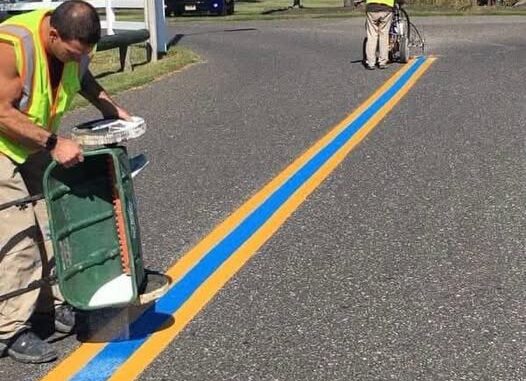
Road markings are an essential part of everyday driving. They help organize traffic, improve safety, and communicate important information to motorists. Most drivers are familiar with white lane markings, yellow center lines, and painted crosswalks, but occasionally, people notice something different—a thin blue line running between the yellow center lines on certain roads.
At first glance, the blue stripe may seem unusual or even confusing. Is it a new traffic rule? Does it indicate a special driving lane? Or is it simply decorative?
The answer depends on where you are.
In some communities across the United States, a blue line painted on the roadway serves as a symbolic tribute to local law enforcement officers. While it isn’t a standard nationwide traffic marking, it has become a meaningful feature in several municipalities that wish to recognize the service of their police departments.
Why Is There a Blue Line on the Road?
Unlike traditional road markings that regulate traffic, these blue lines are generally symbolic rather than instructional.
Communities that choose to install them often do so as a public expression of appreciation for local law enforcement personnel who help protect and serve their neighborhoods.
The blue stripe is typically painted between the existing double yellow center lines, allowing it to remain visible without changing the meaning of official traffic markings.
Its purpose is not to direct traffic but to serve as a visual reminder of the role emergency responders play within the community.
One Well-Known Example
One of the most recognized examples can be found in Ocean City, Maryland.
There, a blue line was added along a section of roadway leading toward the Ocean City Police Department headquarters. Local officials explained that the project was intended as a tribute to the police officers who work in the community.
The roadway itself continues to function like any other public street. Drivers follow the same traffic laws and road markings as before.
The addition of the blue line simply provides a symbolic gesture recognizing the work of local law enforcement.
Does the Blue Line Have Any Legal Meaning?
For most drivers, the answer is no.
The blue stripe does not replace official traffic control devices, nor does it create new driving rules.
Motorists should continue following all existing traffic signs, lane markings, speed limits, and signals regardless of whether a blue line is present.
Since these markings are not part of the nationally standardized system of roadway markings used throughout the United States, their appearance and purpose may vary from one community to another.
Is Every Blue Line the Same?
Not necessarily.
Although several communities have installed symbolic blue lines, there is no universal standard requiring every blue road marking to represent the same thing.
Different municipalities may use colored pavement for various local purposes, public art projects, or community initiatives.
For that reason, if you notice an unusual road marking while traveling, it’s always helpful to consider local signage or information provided by the city or transportation authority.
The Importance of Standard Road Markings
While colored lines sometimes attract attention, the road markings drivers rely on every day remain the most important.
For example:
- Solid yellow lines separate traffic moving in opposite directions.
- Broken yellow lines indicate where passing may be permitted if conditions allow.
- White lane markings separate vehicles traveling in the same direction.
- Crosswalk markings identify designated pedestrian crossing areas.
- Stop lines indicate where vehicles should stop at intersections.
These standardized markings are used consistently throughout the country to improve safety and reduce confusion.
Why Communities Add Symbolic Road Features
Many cities look for meaningful ways to celebrate their local history and recognize the people who contribute to community life.
Some communities install historical markers, murals, memorial gardens, or public artwork.
Others choose symbolic roadway features like painted lines or decorative crosswalks.
These additions often become local landmarks that reflect the identity and values of the area.
A Symbol That Sparks Conversation
Because blue roadway lines are relatively uncommon, they often catch the attention of both residents and visitors.
People unfamiliar with the tradition may wonder whether the line indicates a new traffic regulation or construction project.
In reality, its purpose is often much simpler—a visible symbol intended to acknowledge members of the local law enforcement community.
Like many public memorials, the meaning is rooted more in community recognition than transportation.
The Role of Local Governments
Projects involving painted roadway symbols are typically planned and approved by local governments or transportation agencies.
Before adding any new pavement markings, officials generally consider factors such as:
- Road safety
- Driver visibility
- Local regulations
- Maintenance requirements
- Community input
These considerations help ensure that symbolic additions do not interfere with existing traffic control systems.
Traveling Between Different Communities
One interesting aspect of road travel is that local customs and visual features can vary from place to place.
While the basic rules of the road remain consistent across the country, communities sometimes include unique features that reflect their own history or traditions.
Whether it’s a painted mural at an intersection, decorative crosswalks, or a symbolic blue line, these local touches help give each community its own character.
For travelers, they can also become interesting conversation starters and reminders that every town has its own story.
Staying Focused Behind the Wheel
Although unusual road markings may catch your attention, it’s always important to keep your focus on safe driving.
Drivers should continue paying attention to:
- Traffic signals
- Posted speed limits
- Lane markings
- Pedestrians
- Cyclists
- Weather conditions
- Other vehicles
Decorative or symbolic roadway features should never distract from safe driving practices.
More Than Just Paint
For communities that have chosen to install blue roadway lines, the marking often represents appreciation, service, and local pride.
Whether someone views it as a meaningful tribute, an interesting civic feature, or simply another unique part of a city’s identity, the blue line has become a recognizable symbol in several areas where it has been adopted.
At the same time, it remains separate from official traffic regulations, meaning drivers should continue following all standard road rules regardless of its presence.
Final Thoughts
Seeing a blue line painted between yellow center lines may come as a surprise if you’ve never encountered one before.
In certain U.S. communities, these markings serve as symbolic tributes to local law enforcement rather than official traffic instructions. They reflect community appreciation while leaving the normal rules of the road unchanged.
As with many local traditions, the meaning behind the blue line depends on where you are. It serves as a reminder that roads can sometimes tell stories beyond transportation—stories about the people, history, and values that help shape a community.
Leave a Reply