
Most people assume meaningful change comes from grand gestures, large donations, or organized efforts. But sometimes, the actions that leave the biggest impact begin with something much smaller—a moment of kindness that reminds others what truly matters.
That lesson became clear in our neighborhood after an unexpected chain of events involving my six-year-old son, an elderly neighbor, and a community that quietly came together when someone needed help.
It all started with a simple observation.
Our neighbor, Mrs. Adele, had lived across the street for as long as I could remember. She was the kind of person who always waved from her porch, remembered birthdays, and somehow knew every child’s name in the neighborhood.
Although she lived alone, she always seemed independent and self-sufficient. Like many busy adults, I assumed everything was fine unless I heard otherwise.
My son, Oliver, paid much closer attention.
One afternoon while we were outside, we noticed Mrs. Adele standing near her mailbox holding a stack of envelopes. She smiled when she saw us, but something seemed different.
“Hi, Mrs. Adele!” Oliver shouted enthusiastically.
She smiled back.
“Hello, Oliver. How’s my favorite dinosaur expert today?”
He grinned.
“Still learning,” he replied.
They exchanged a few words before we continued our day, but I couldn’t help noticing she seemed distracted. Looking back, there were signs that something wasn’t quite right.
Unfortunately, I was too busy to think much about it.
A few days later, Oliver pointed out something I hadn’t noticed.
“Mom,” he said while getting ready for bed, “Mrs. Adele’s porch light hasn’t been on.”
I looked outside.
Sure enough, the house across the street sat completely dark.
At first, I assumed she had gone to bed early.
But the following night, the porch remained dark again.
And the night after that.
While I dismissed it as a possibility, Oliver couldn’t stop thinking about it.
To him, routines mattered.
Mrs. Adele always turned her porch light on in the evening.
Always.
Children often notice details adults overlook.
The next day, Oliver walked into the kitchen carrying his favorite green piggy bank.
He placed it carefully on the table.
“I want to help Mrs. Adele,” he announced.
I smiled, assuming he meant bringing cookies or drawing a picture.
Instead, he pushed the piggy bank toward me.
“She might need money.”
His words caught me off guard.
I tried explaining that adult problems are usually more complicated than that.
But Oliver remained determined.
“If somebody needs help,” he said, “you help them.”
Simple.
Direct.
Impossible to argue with.
That afternoon, we walked across the street together.
When Mrs. Adele opened the door, I immediately realized something was wrong.
The house felt unusually cold.
She was wearing a heavy coat indoors despite the mild weather outside.
After a brief conversation, we learned that she had been struggling with utility issues and was waiting for assistance from a relative who managed some of her finances.
She repeatedly insisted everything was under control.
Then Oliver stepped forward.
Without saying much, he held out his piggy bank.
“I want you to have this,” he said.
Mrs. Adele looked stunned.
She tried to refuse.
Oliver wouldn’t let her.
“You need it more than I do.”
For several seconds, nobody spoke.
Finally, she accepted the gift with tears in her eyes.
It was a small gesture, but it clearly meant a great deal to her.
Before we left, she bent down and whispered something to Oliver.
He smiled but didn’t tell me what she said.
I didn’t think much of it at the time.
The next morning changed everything.
I woke up to repeated knocking at the front door.
When I opened it, I was surprised to find a local police officer standing outside.
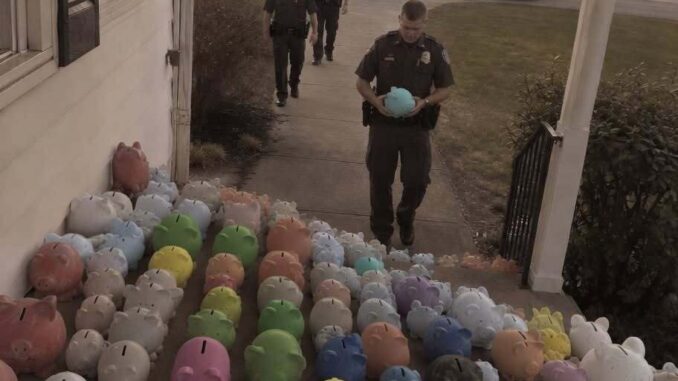
Behind him was a sight I could hardly believe.
Our yard was covered with piggy banks.
There were ceramic piggy banks, plastic piggy banks, old-fashioned piggy banks, and even handmade ones. They lined the walkway, filled flower beds, and stretched across the lawn.
Several patrol vehicles were parked nearby.
For a brief moment, I worried something terrible had happened.
Before I could ask, my sleepy son appeared beside me.
“Am I in trouble?” he asked quietly.
The officer smiled.
“Not at all.”
He explained that word of Oliver’s gift to Mrs. Adele had spread through the community overnight.
As people heard the story, many realized they shared something in common.
Mrs. Adele had helped them at some point in their lives.
One by one, neighbors began arriving.
Each brought a piggy bank.
Inside weren’t just coins.
There were handwritten notes, small gifts, keepsakes, and messages of gratitude.
The stories were remarkable.
One local business owner explained that Mrs. Adele had quietly helped him during a difficult period when he was young.
A teacher described how she had encouraged struggling students for years.
A nurse recalled receiving support from Mrs. Adele when her family was facing challenges.
A retired police officer shared a similar story.
Again and again, people described moments when Mrs. Adele had offered help, encouragement, kindness, or simply made them feel seen during difficult times.
Most of those acts had happened years ago.
Yet nobody had forgotten.
As the morning continued, it became clear that Mrs. Adele’s impact reached far beyond our small street.
For decades, she had quietly supported people without expecting recognition or praise.
Many of those individuals had gone on to build successful lives and careers.
Now they wanted an opportunity to give something back.
What began as one child’s attempt to help had sparked a community-wide response.
The attention wasn’t about money.
It was about appreciation.
It was about remembering someone whose kindness had touched countless lives.
Later that day, neighbors organized practical support as well.
People volunteered to help with household tasks, transportation, repairs, and ongoing assistance.
Others offered professional services.
Instead of temporary help, they created a long-term support network.
Most importantly, Mrs. Adele no longer felt alone.
That evening, after the crowds had gone home and the excitement settled down, I tucked Oliver into bed.
Before turning off the light, I finally asked the question I’d been wondering about.
“What did Mrs. Adele whisper to you that day?”
He yawned and smiled.
“She said being kind is important,” he replied.
Then he added something I’ll never forget.
“She said people remember how you make them feel.”
As I looked out the window later that night, I noticed something that hadn’t been there for days.
Mrs. Adele’s porch light was glowing again.
It wasn’t particularly bright.
But somehow, it seemed to illuminate far more than just her front yard.
It served as a reminder that kindness often creates ripples we never see.
Sometimes those ripples travel quietly through years and across entire communities.
And sometimes all it takes is one small act from one caring child to bring those ripples back to the surface.
Leave a Reply