
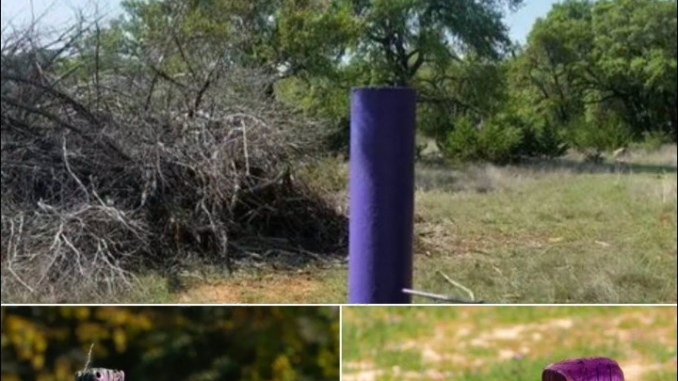
When you’re walking through a quiet rural road, a wooded hiking trail, or passing farmland far from city limits, the landscape tends to feel open, calm, and unmarked. Fences blend into the environment, usually painted in familiar tones—weathered wood, whitewash, rusted wire, or faded gray posts that have absorbed years of sun and rain.
So when you suddenly notice something different—a fence post marked in bright purple—it can feel out of place. Almost like a mistake. Or someone experimenting with paint.
But in many regions, especially across parts of the United States, that purple mark is not decoration at all.
It is a legal warning.
And it means something very specific: no trespassing.
A Color That Speaks Without Words
Unlike traditional “No Trespassing” signs that can be nailed, removed, damaged, or ignored, purple paint markings were designed to be a more permanent and efficient form of communication. Instead of relying on signs that require maintenance and visibility checks, landowners use paint as a long-term boundary signal.
The idea is simple: a color that is rare in nature, easy to see, and consistent in meaning.
Over time, purple became the chosen standard in several jurisdictions because it stands out sharply against natural surroundings—green forests, brown soil, gray wood, and pale grasses. A vertical purple stripe on a fence post is hard to mistake for anything accidental.
It is intentional. And that is exactly the point.
How the Purple Paint Law Came to Be
The use of purple paint as a legal boundary marker did not begin as a widespread cultural trend. It started as a practical solution in rural communities where property lines were large, remote, and difficult to monitor.
Posting signs every few hundred feet across acres of land was expensive and impractical. Signs also deteriorate quickly in weather conditions—wind tears them down, sunlight fades them, and animals or vandals can damage them.
In response, lawmakers in several states began recognizing painted markings as a valid alternative.
One of the earliest formal adoptions came in the late 1990s when states such as Arkansas legalized purple paint as an official “No Trespassing” indicator. From there, other states followed with similar legislation, allowing landowners to mark trees, fence posts, and boundary points using specific paint rules.
Today, purple paint laws exist in multiple rural regions across the United States, especially in areas with large agricultural land, forests, or private hunting grounds.
The Rules Behind the Markings
Although it might look like a casual brush of paint, purple boundary markings are regulated in very specific ways to ensure clarity and legal recognition.
In most places where the law applies, the markings must follow strict guidelines:
First, the paint must be applied in a vertical stripe, not random blotches or horizontal lines. This prevents confusion with accidental marks or vandalism.
Second, the stripe must meet a minimum size—typically large enough to be visible from a reasonable distance. If it’s too small, it loses its purpose. If it’s too large or messy, it may not be considered valid under local law.
Third, placement matters. The marks are usually required at a visible height on fence posts or trees, often between waist and eye level, so they can be seen clearly while walking.
Finally, spacing is important. Property owners generally place these marks at regular intervals along boundaries so that anyone approaching the land understands they are crossing into private property.
When done correctly, these markings carry the same legal weight as a physical “No Trespassing” sign.
Why Purple? The Psychology Behind the Choice
At first glance, purple may seem like an unusual choice for a legal warning. Why not red, which signals danger? Or orange, which is commonly used in construction zones?
The answer is partly practical and partly psychological.
Purple is uncommon in natural rural environments. Unlike green or brown, it does not blend into vegetation. Unlike yellow or orange, it is not widely used in farming or road signage. This rarity makes it instantly noticeable.
There is also a psychological dimension. Purple has historically been associated with authority, importance, and exclusivity. Because it was once a rare dye reserved for royalty and wealth, it still carries subtle associations with something valuable or protected.
That subconscious association works in the landowner’s favor. Even without knowing the law, most people instinctively interpret the color as intentional and meaningful.
In short, it communicates: this is not random land. This is claimed and protected.
Where You’re Most Likely to See It
Purple paint markings are not typically found in urban environments. Instead, they are most common in rural and semi-rural regions where property boundaries stretch across large areas.
You might encounter them while hiking through wooded trails, walking near farmland, exploring forest edges, or traveling along backroads where private land borders public access points.
They are also sometimes used in hunting areas or large privately owned tracts where traditional fencing is impractical.
In some cases, the markings may appear on trees rather than fence posts, especially in heavily forested regions where natural boundaries replace man-made ones.
What You Should Do If You See One
The most important thing to understand is simple: a purple paint mark is not decorative. It is a boundary signal.
If you see it on a fence, tree, or post, you should treat it the same way you would a clearly posted “No Trespassing” sign. That means stopping, reassessing your path, and ensuring you are not entering private land.
Even if the surrounding area looks open or uninhabited, the markings indicate that someone legally owns and monitors the property.
Ignoring them can lead not only to confrontation with landowners but also potential legal consequences in jurisdictions where the law is enforced.
A Quiet System That Prevents Bigger Conflicts
What makes the purple paint system interesting is not just its legality, but its efficiency. It reduces the need for repeated signage, minimizes environmental clutter, and provides a long-lasting way for landowners to communicate boundaries clearly.
It is a system built on simplicity: one color, one meaning.
No confusion. No ambiguity. No need for interpretation.
Final Thoughts
In a world filled with signs, warnings, and digital notifications competing for attention, a small streak of purple paint on a fence post might seem insignificant.
But in certain places, it carries real legal weight.
It is a reminder that land is still divided, owned, and protected—even in landscapes that feel open and free.
So the next time you’re walking a rural path or passing through quiet countryside and notice that unusual splash of purple, don’t overlook it.
It isn’t art.
It isn’t decoration.
It is a clear, silent message written in color:
You are approaching private property—and you should turn back.
Leave a Reply