
The first thing you notice is the speed.
Not normal bug speed.
Not the slow, predictable crawl of an ant or the clumsy flutter of a moth near a lamp.
This thing moves like panic itself.
One second the floor is empty. The next, something with far too many legs streaks across the tile so fast your brain barely processes the shape before your nervous system decides it’s a threat.
That was exactly what happened to me.
I had gotten out of bed around two in the morning for a glass of water when I saw movement near the bathroom doorway. At first I thought it was a spider. Then I thought it might be some kind of mutant roach.
Then it stopped under the hallway light.
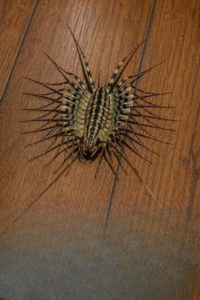
Long antennae.
Thin striped body.
Legs everywhere.
Too many legs.
I froze.
Because some fears don’t wait for logic. They arrive fully formed.
And house centipedes seem almost designed to trigger that reaction.
The Creature Behind the Fear
The strange part is that despite how terrifying they look, house centipedes are actually among the least dangerous creatures you might find in a home.
They don’t invade in the way pests do. They’re not interested in humans at all. In most cases, they’re simply trying to avoid being seen.
They are hunters, not invaders.
House centipedes thrive in dark, damp spaces where other small insects gather—bathrooms, basements, laundry rooms, crawl spaces, and storage areas. Those environments also happen to be where their food lives.
And that food list is surprisingly familiar:
Cockroaches
Silverfish
Ants
Spiders
Termites
Bed bugs
Moths
In other words, many of the insects people actively try to eliminate are already being hunted by the fast-moving creature on your wall at midnight.
That changes the way you see it.
What Their Presence Actually Means
Most people assume the centipede is the problem.
In reality, its presence often signals something else: a hidden population of pests nearby.
House centipedes appear at night because that’s when many of their prey are active. Their long legs allow them to move quickly, climb walls, and intercept insects with remarkable efficiency.
They use venom to immobilize prey—but that word is more alarming than the reality.
For humans, it is largely harmless.
House centipedes are technically venomous, but their venom is designed for insects, not people. They almost never bite humans, and when they do, it usually feels like a mild sting or irritation at worst.
Their instincts are focused on escape, not confrontation.
Why They Look So Disturbing
Even with all that reassurance, the reaction they trigger is hard to override.
Everything about them feels wrong at first glance.
The speed.
The sudden movement.
The twitching antennae.
The dozens of legs moving in coordinated chaos.
Fear doesn’t always come from danger. Sometimes it comes from unpredictability.
And house centipedes are extremely unpredictable to human perception.
A Misunderstood Ally in the Home
Once people understand what house centipedes actually do, many stop seeing them as something to kill immediately.
Some choose to remove them carefully and release them outside. Others focus on prevention instead—reducing humidity, fixing leaks, sealing cracks, and removing the insects that attract them in the first place.
Because if house centipedes are thriving indoors, it usually means something else is thriving too.
Ironically, the creature that looks like the problem is often responding to one.
The Unlikely Role They Play
Pest control experts often describe house centipedes as beneficial predators in indoor environments. Unlike pests that damage property or spread disease, they hunt insects that do.
In a strange way, they function like natural pest control—quiet, efficient, and largely invisible.
Disturbing-looking exterminators.
But effective ones.
Why Fear Doesn’t Fully Go Away
Even after learning all of this, instinct doesn’t disappear.
Knowledge changes understanding. It doesn’t always change reaction speed at 2 A.M.
So the initial jump, the discomfort, the reflex to step back—that part often remains.
But what changes is the interpretation afterward.
Instead of seeing something dangerous, you start to see something functional.
A small predator doing a job most people never notice needs doing.
Final Thought
The next time one darts across your floor, you’ll probably still feel that instinctive jolt.
That’s normal.
But behind that reaction is a simple reality:
The unsettling little creature racing for the shadows is usually hunting things far more unwanted than itself.
In the hidden ecosystem of a home, not everything frightening is an enemy.
Sometimes, the scariest-looking thing in the room is quietly helping keep worse things out of it.
Leave a Reply