

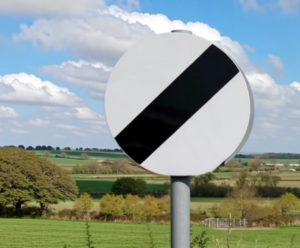
A simple road sign in the UK has been quietly confusing drivers for years, sparking debates online and even catching out experienced motorists during theory test revisions. At first glance, it looks almost too plain to be important: a circular white sign with a thick black diagonal stripe running through it.
No numbers. No arrows. No obvious instructions.
And yet, this sign carries one of the most important meanings on the road.
It represents the national speed limit.
A Sign That Looks Simple—but Isn’t Always Understood
Despite its simplicity, many drivers admit they forget exactly what it means after passing their driving test. Online forums often joke that it means “go as fast as you want” or “end of all restrictions,” but these interpretations highlight a real issue: the sign is visually familiar but not always fully understood.
In reality, it does not give permission to speed freely. Instead, it signals that default UK speed limits now apply depending on the type of road and vehicle being driven.
From this point onward, drivers are expected to know the legal limits without repeated signage.
What the National Speed Limit Actually Means
When a driver passes this sign, it means they are entering a stretch of road where national speed rules apply rather than a specifically posted limit.
For most standard passenger cars, the rules are:
- 60 mph on single carriageways
- 70 mph on dual carriageways and motorways
However, these are maximum limits—not targets. Drivers must still adjust speed based on conditions such as traffic, weather, visibility, and road surface.
A clear motorway may safely allow 70 mph, but in heavy rain or fog, that speed can become dangerous or even illegal under careless or dangerous driving laws.
So the sign is less an instruction to accelerate and more a reminder that no local limit is posted.
It Affects Different Vehicles Differently
The national speed limit sign does not apply equally to all vehicles.
Larger or heavier vehicles have lower limits, such as:
- Vehicles towing trailers
- Vans and heavy goods vehicles
- Certain buses and coaches
For these, the typical limits are:
- 50 mph on single carriageways
- 60 mph on dual carriageways and motorways
This distinction exists because heavier vehicles require longer braking distances and have different stability characteristics.
Urban Roads Still Follow Their Own Rules
The national speed limit sign does not override built-up area limits.
In the UK, roads with street lighting generally default to 30 mph unless otherwise signed. This applies even if a driver has previously passed a national speed limit sign on another road.
Common urban limits include:
- 20 mph zones near schools or residential areas
- Variable limits in construction zones
- Locally enforced reductions in high-risk areas
Understanding how these systems interact is key to avoiding confusion.
Why the Sign Causes So Much Confusion
Part of the confusion comes from how minimal the design is. There are no numbers or words—only a symbol.
For drivers who rely on visual cues, this can make the meaning easy to misinterpret or forget.
Another issue is repetition. Unlike other speed limit signs, this one usually appears only when limits change. After that, drivers are expected to remember what applies.
Over time, especially for occasional drivers, this knowledge can fade.
Even experienced motorists sometimes misjudge speed limits when switching between road types.
What Road Safety Experts Say
Road safety organizations such as the RAC and UK transport authorities emphasize that understanding road signs is essential not just for testing, but for ongoing safety.
They note that the national speed limit sign is often misunderstood not because it is complex, but because it requires applying knowledge rather than following a direct instruction.
In other words, it is a reminder of rules rather than a rule itself.
Experts also stress that speed limits are based on road design, traffic flow, and accident risk—not just legality. Driving under the limit is not always safe if conditions require greater caution.
A Reminder That Knowledge Needs Refreshing
Confusion around this sign has led educators to encourage periodic refresher learning, even for experienced drivers. Road systems evolve, and driving habits change over time.
A simple-looking sign can still carry serious meaning—and misunderstanding it can have consequences.
As one instructor put it:
“It’s not the sign that’s unclear. It’s the assumption that we already know everything about it.”
Final Thought
The next time you see a circular sign with a black diagonal stripe, it is not telling you to speed up or slow down blindly.
It is telling you something more important:
You are now driving under national rules, and it is your responsibility to know what they are.
Because on the road, the smallest signs often carry the biggest consequences.
Leave a Reply