
A sunny afternoon at the beach is usually filled with simple pleasures—building sandcastles, collecting seashells, and watching waves roll onto the shore. But sometimes, an ordinary day by the water can lead to a discovery that sparks curiosity and imagination.
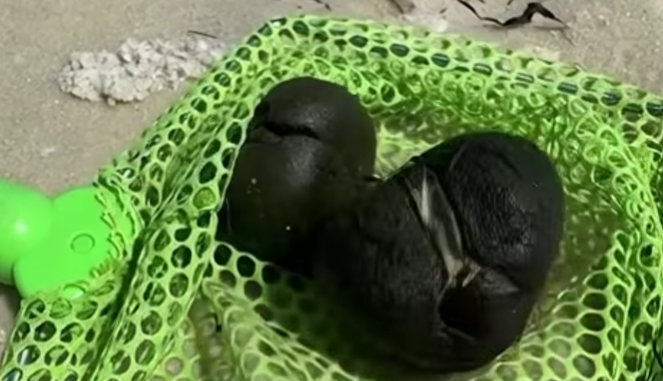
That’s exactly what happened when several children exploring the shoreline stumbled upon a collection of unusual objects scattered across the sand. The strange spheres were dark, round, and slightly soft to the touch. At first glance, they looked almost artificial, as though they had washed ashore from somewhere far away.
Excited by their discovery, the children gathered the mysterious objects and rushed to show nearby adults. Before long, speculation began spreading across the beach. Some wondered if they were eggs from a marine creature. Others suggested they might be remnants of an unusual plant species or even debris carried in by ocean currents.
As more people examined the strange formations, curiosity quickly grew.
The objects appeared surprisingly uniform. Most were roughly the size of a tennis ball, although some were smaller or larger. Their dark color and smooth texture made them stand out against the pale sand, giving them an almost unnatural appearance.
Photos soon circulated among beachgoers, and questions followed.
What exactly were these mysterious balls?
Were they rare?
Were they dangerous?
The answer, as it turned out, was far less alarming—but no less fascinating.
Experts explained that the unusual discoveries were actually mudballs, naturally occurring formations commonly found in bays, estuaries, and calm coastal environments.
While the name might sound unimpressive, the process behind their creation is remarkably interesting.
Unlike beaches exposed to constant crashing waves, sheltered bays often contain areas where fine sediments can settle undisturbed. Tiny particles of mud, clay, organic matter, and decaying vegetation gradually accumulate on the bottom over long periods of time.
Eventually, changes in water movement, weather conditions, or shoreline activity cause small portions of this material to break loose.
Once separated, these fragments begin a slow transformation.
Gentle currents roll them along the bottom, turning them over repeatedly. As they move, additional layers of sediment cling to the surface while friction smooths away rough edges.
Over time, the process shapes the material into rounded forms that resemble balls.
The phenomenon is surprisingly similar to how river stones become smooth after years of being carried by flowing water.
Nature acts as a patient sculptor.
With enough time, even soft sediment can be shaped into something unexpectedly uniform.
The dark color commonly seen in mudballs comes from organic materials trapped within the sediment. Decaying plant matter, algae, and other natural substances become mixed into the mud, producing shades that range from deep brown to dark green or nearly black.
Although their appearance can seem unusual, mudballs are generally harmless.
Most are odorless and hold their shape well enough to be gently handled. Their texture often feels firm yet slightly soft, depending on how recently they formed and how much water they contain.
Occasionally, some mudballs may emit an unpleasant smell. This typically occurs when larger amounts of decomposing organic material are trapped inside.
In such cases, it’s best to leave them undisturbed.
For the most part, however, these formations are simply another example of nature’s ability to create surprising shapes from ordinary materials.
What makes mudballs especially interesting is the way they encourage curiosity.
Many people spend years walking beaches without ever noticing them. Yet once someone points them out, they become impossible to ignore.
Children, in particular, are often fascinated by the discovery.
A strange object on the shoreline naturally inspires questions.
Where did it come from?
How was it made?
Why does it look that way?
Those questions often lead to conversations about ecosystems, geology, tides, sediment movement, and the countless natural processes constantly shaping coastal environments.
In that sense, mudballs become much more than odd-looking objects.
They become teaching tools.
For generations, coastal communities have encountered these unusual formations during walks along the shore. While they may not receive the same attention as seashells, sea glass, or driftwood, they remain a memorable part of the beach experience for many families.
The discovery also serves as a reminder that nature doesn’t always reveal its secrets in dramatic ways.
Sometimes the most fascinating discoveries aren’t rare creatures or hidden treasures.
Sometimes they’re simple formations created by ordinary processes working quietly over time.
The children who found the mysterious spheres may have expected an extraordinary explanation. Instead, they uncovered something equally remarkable—a glimpse into the subtle forces that shape the natural world every day.
What first appeared to be a mystery turned out to be a lesson in patience, geology, and environmental balance.
And perhaps that’s what makes discoveries like these so special.
They remind us that wonder doesn’t always come from the unknown.
Sometimes it comes from understanding the ordinary.
The next time you find yourself walking along a quiet shoreline, keep an eye on the sand beneath your feet. Among the shells and driftwood, you might spot one of these unusual natural creations.
At first glance, it may look strange.
But its story is one that has been written by water, sediment, and time itself.
And that makes it far more interesting than any mystery could ever be.
Leave a Reply