
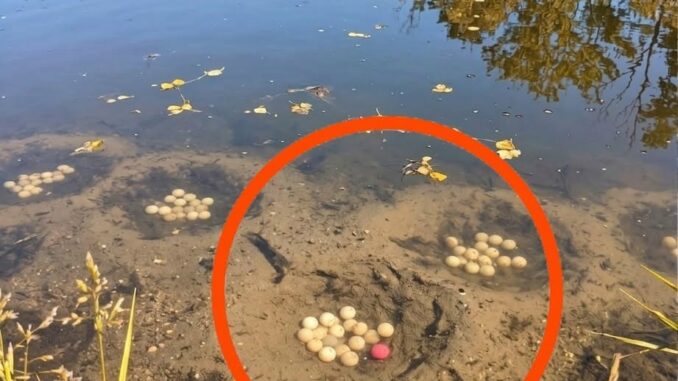
A peaceful walk around a village lake is usually a chance to enjoy nature, relax, and take in the scenery. Most days, the sights are familiar: birds gliding across the water, fish occasionally breaking the surface, and gentle ripples moving through the shallows.
One day, however, an unusual sight stopped me in my tracks.
Scattered throughout the shallow water were dozens of pale, rounded objects that looked remarkably like eggs. They appeared almost perfectly arranged, clustered together in groups that seemed too organized to be random.
At first glance, the discovery felt both fascinating and unsettling.
An Unexpected Discovery
The artificial lake in our village has always been a favorite place for residents to walk and enjoy the outdoors.
Because I visit regularly, I am familiar with most of the plants, birds, and wildlife that live there.
That is why the strange objects immediately caught my attention.
They stood out against the darker water and muddy shoreline.
From a distance, they resembled oversized eggs resting beneath the surface.
Their unusual appearance sparked countless questions.
Had an animal laid them?
Were they part of some aquatic plant?
Had someone placed them there intentionally?
The possibilities seemed endless.
When Curiosity Meets Imagination
Human beings naturally try to explain unfamiliar sights.
When we encounter something unusual, our brains immediately begin searching for answers based on past experiences and familiar patterns.
In this case, the rounded shapes strongly resembled eggs.
That resemblance made it easy to imagine all sorts of explanations.
For a few moments, I found myself wondering whether some large creature had visited the lake during the night.
The scene felt almost otherworldly.
Yet the more I observed, the more curious I became.
Looking More Closely
Rather than jumping to conclusions, I decided to take a closer look.
As I moved nearer to the water’s edge, I began noticing details that were not visible from a distance.
The objects appeared slightly translucent.
Some were attached to one another.
Others seemed to contain darker material inside.
Instead of becoming clearer, the mystery only deepened.
Fortunately, nature often provides answers to those willing to investigate patiently.
A Common Natural Phenomenon
After researching and comparing photographs, I discovered that the mysterious “eggs” were likely gelatinous egg masses produced by amphibians.
Many species of frogs and toads lay their eggs in clusters or jelly-like masses within ponds, lakes, wetlands, and other calm bodies of water.
These egg masses can contain dozens or even hundreds of developing embryos.
When viewed from a distance, they often resemble large floating bubbles, translucent spheres, or collections of pale eggs.
To someone unfamiliar with amphibian reproduction, the sight can appear quite unusual.
Why Frog Eggs Look So Strange
Unlike bird eggs, amphibian eggs are typically surrounded by a protective jelly-like coating.
This coating serves several important purposes:
- Protecting developing embryos
- Retaining moisture
- Providing insulation
- Helping reduce predation
- Allowing oxygen exchange
As sunlight passes through the gelatinous material, the clusters can appear bright, pale, or even glowing beneath the water.
Different species create different patterns, making identification an interesting challenge for nature enthusiasts.
The Importance of Amphibians
Although they often go unnoticed, amphibians play a vital role in healthy ecosystems.
Frogs, toads, and salamanders contribute to environmental balance by:
- Controlling insect populations
- Serving as food sources for other wildlife
- Helping scientists monitor ecosystem health
- Supporting biodiversity
Because amphibians are sensitive to environmental changes, their presence often indicates a relatively healthy habitat.
The appearance of egg masses can therefore be a positive sign for local ecosystems.
Leave a Reply