

My grandson Caleb was only nine years old when his school decided he couldn’t attend its annual Father-Son Breakfast.
His father had died serving his country.
I offered to take his place.
But the headmaster told us that grandfathers weren’t allowed.
What happened when I showed up in my old Navy uniform changed more than just one little boy’s morning.
It changed the entire school.
The Photograph My Grandson Never Went Anywhere Without
My name is Frank Halloran. I’m eighty-one years old, a retired United States Navy Chief Petty Officer, and the grandfather of a remarkable little boy named Caleb.
Caleb has his father’s ears. They stick out slightly, especially when he smiles.
He also has his father’s habit of becoming quiet when something hurts.
And he carries a photograph of his dad everywhere.
It’s a small, square picture, slightly bent at one corner.
In it, my son Danny is sitting on the back steps of our house in Norfolk, Virginia, holding eighteen-month-old Caleb on his knee.
They’re both laughing.
I remember taking that picture.
I was standing behind the camera, pretending to bark like a dog.
Caleb keeps the photograph inside a plastic sandwich bag, tucked into a hidden pocket of his backpack.
He’s carried it since kindergarten.
Sometimes, when he thinks nobody is watching, he’ll unzip that pocket and look at his father’s face.
Then he’ll carefully put the photograph away.
Danny died in Afghanistan in August 2019.
He was a Navy corpsman attached to a Marine unit in Helmand Province.
When a roadside bomb struck his patrol, two Marines were badly wounded.
My son ran into the smoke to save them.
Both men survived.
Danny didn’t.
He was thirty-one years old.
Caleb was two.
I’d spent twenty-eight years serving in the Navy, from 1963 until 1991. I’d worked on aircraft carriers, supervised flight-deck operations, and helped fight fires at sea.
After retiring, I worked as a fire safety inspector in Norfolk.
My wife, Peg, and I raised three children in our little brick house near the naval station.
Danny was our youngest.
Peg died of cancer in 2015.
Four years later, we lost Danny.
I don’t think a parent ever truly recovers from burying a child.
After his funeral, Danny’s wife, Jess, moved back to Norfolk with Caleb.
She had lost her own parents years earlier, so we became each other’s family.
Eventually, Jess and Caleb moved into the house with me.
Three people trying to make a life out of what remained.
The School’s Rule That Broke Caleb’s Heart
Caleb attended Hampton Roads Preparatory Academy, a private school in Virginia Beach.
We could never have afforded the tuition ourselves.
But the academy offered a scholarship through its Gold Star Fund for children whose parents had died in military service.
Caleb received that scholarship when he was five.
Every spring, the academy held a Father-Son Breakfast.
It was a formal affair, with white tablecloths, a guest speaker, and photographs taken beneath a large magnolia tree.
When Caleb was in kindergarten, Jess had attended with him.
She wore a blazer and tie and even drew a mustache on her face.
Caleb thought it was hilarious.
The headmaster at the time welcomed them warmly.
But after she retired, a new headmaster took over.
His name was Dr. Graham Prentiss.
One afternoon in April, Caleb came home from school and went straight to his bedroom.
I found a letter on the kitchen counter.
It announced the upcoming Father-Son Breakfast.
This year’s guest speaker would be retired four-star Admiral James R. Carrick.
But one paragraph caught my attention.
Students who didn’t have a father attending were instructed to wait in the library, where refreshments would be provided.
I read that sentence several times.
Then I went to Caleb’s room.
He was sitting on his bed with his backpack open.
In his hands was the little photograph of Danny.
When he saw me, he quickly put it away.
“It’s okay, Grandpa,” he said.
Then he forced a smile.
“I don’t really like pancakes that much anyway.”
I knew he was lying.
Caleb loved pancakes.
What he didn’t want was for me to see how badly he’d been hurt.
The next morning, Jess called the school.
She explained that Caleb’s father had died in Afghanistan and asked whether I could attend the breakfast with him.
The headmaster’s assistant put her on hold.
When she returned, the answer was no.
Dr. Prentiss believed the event should be reserved strictly for fathers and sons.
A grandfather, apparently, didn’t fit the theme.
Jess reminded the assistant that the school itself had awarded Caleb a scholarship because his father had died in service.
The answer didn’t change.
Caleb could wait in the library.
There would be juice and muffins.
Jess ended the call and began crying quietly at the kitchen table.
I sat across from her, looking through the window at the backyard where Danny had played as a boy.
Then I stood up.
“Where are you going?” Jess asked.
“Upstairs.”
The Uniform I Hadn’t Worn Since My Son’s Funeral
There was a cedar closet in the upstairs hallway.
Peg had it built decades earlier.
Inside, behind her old winter coat that I still couldn’t bring myself to donate, hung a black garment bag.
I unzipped it.
My Navy dress blues.
The jacket was dark navy wool with gold buttons.
There were service stripes on the sleeve and rows of ribbons across the chest.
Among them was the Navy and Marine Corps Medal.
I hadn’t worn that uniform since Danny’s funeral.
I’d stood in it at Arlington, watching sailors fold the flag from my son’s coffin.
I’d watched a Navy officer present that flag to Jess.
And I’d watched two-year-old Caleb sitting on his mother’s lap, too young to understand what was happening.
Afterward, I’d put the uniform away.
I never expected to wear it again.
But that afternoon, I laid it carefully across my bed.
Jess appeared in the doorway.
“Frank, what are you doing?”
I looked at her.
“I’m taking my grandson to breakfast.”
She stared at the uniform.
Then she began to understand.
There was something about that uniform I’d never told my family.
Something that happened in 1972.
And it was about to become the reason a four-star admiral would walk across a crowded gymnasium to find me.
The Young Sailor I Saved in 1972
In April 1972, I was twenty-seven years old and serving aboard an aircraft carrier in the Gulf of Tonkin.
I was a First Class Petty Officer assigned to the hangar deck.
It was dangerous work.
Aircraft were constantly being moved, repaired, and refueled.
There were fuel lines, hydraulic systems, heavy equipment, and weapons stored nearby.
One afternoon, a fuel line ruptured while an A-7 Corsair was being refueled.
Jet fuel spread across the deck.
A spark ignited it.
Within seconds, the hangar bay was engulfed in flames.
The heat was unbearable.
Black smoke filled the compartment.
Fire alarms sounded throughout the ship.
I was part of the firefighting team.
We knew the flames could reach nearby weapons if we didn’t contain them quickly.
Then I noticed a young sailor sitting behind the wheel of a tow tractor.
He was supposed to move an aircraft away from the fire.
But he wasn’t moving.
His hands were gripping the steering wheel.
His eyes were fixed on the flames.
He was completely frozen with fear.
I climbed onto the tractor and grabbed his collar.
“Look at me, sailor!”
He didn’t respond.
I shouted again.
Finally, his eyes met mine.
“What’s your name?”
“Carrick,” he whispered.
“First name?”
“Jimmy.”
I put my hand on his shoulder.
“Jimmy, listen to me. You’re going to be okay. We’re getting out of here together.”
I placed my hands over his on the steering wheel.
“Turn left.”
He turned.
“Now move forward. Slowly.”
The tractor began moving.
We pulled the aircraft away from the flames and into the next section of the hangar.
The fire doors closed behind us.
Moments later, flames reached the place where the tractor had been.
If we’d stayed there, neither of us would have survived.
The firefighting team eventually contained the blaze.
Several sailors were injured, but nobody died.
That night, I found Jimmy sitting on his bunk, shaking.
“I froze,” he whispered. “I nearly got us killed.”
I sat beside him.
“Everybody gets scared, Jimmy.”
He looked at me.
“What matters is that you moved when someone helped you.”
I placed my hand on his shoulder again.
“Sometimes courage is just finding the strength to move when somebody’s there to guide you.”
Then I told him something else.
“One day, you’ll be the person helping someone else through their fear.”
Three weeks later, I received the Navy and Marine Corps Medal for my actions during the fire.
Jimmy transferred to another assignment later that year.
I never saw him again.
I didn’t know what became of him.
For more than fifty years, I rarely spoke about that afternoon.
Until the day of Caleb’s breakfast.
The Morning I Walked Into the Gymnasium
I woke up at five.
I shaved carefully, polished my old black shoes, and put on my dress uniform.
It was tighter around the waist than I remembered.
My shoulders had become narrower with age.
But the jacket still buttoned.
I arranged my ribbons and checked their placement with a ruler.
The hardest part was fastening the collar.
My arthritic fingers wouldn’t cooperate.
I called Jess upstairs.
When she entered the room, she stopped.
Her eyes filled with tears.
“Frank,” she whispered. “You look like Danny.”
I smiled sadly.
“Could you help me with this collar?”
She stepped forward and fastened it.
Then she straightened my tie.
For a moment, she rested her forehead against my chest.
“Thank you,” she whispered.
Caleb came into the hallway shortly after seven.
He was wearing his school blazer.
When he saw me, he stopped walking.
His eyes widened.
“Grandpa?”
“Morning, son.”
He stared at the uniform.
“You look just like Dad.”
I knelt in front of him, my knees cracking loudly.
“Actually, your dad looked like me.”
That made him smile.
Then he remembered the school letter.
“But Grandpa, they said you can’t come.”
“I know.”
“You’re going to get in trouble.”
I stood up slowly.
“Son, I’ve dealt with tougher people than your headmaster.”
Then I held out my hand.
“Come on. We’ve got a breakfast to attend.”
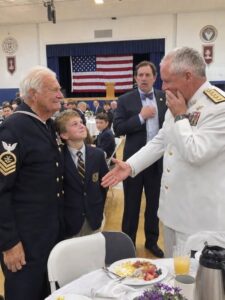
At 7:25, we walked into the academy gymnasium.
There were about two hundred fathers and sons seated around tables covered in white linen.
The room was beautifully decorated.
A string quartet played near the wall.
But as Caleb and I entered, the conversations began to fade.
People turned toward us.
An elderly man in Navy dress blues.
And a little boy holding his hand.
Caleb hadn’t held my hand in public for years.
But that morning, he gripped it tightly.
We found an empty table near the back of the room.
I pulled out his chair.
Then I sat beside him.
“Want some pancakes?”
He looked around nervously.
“Everybody’s staring.”
“Let them,” I replied. “Pancakes or eggs?”
“Pancakes.”
He’d barely settled into his chair when Dr. Prentiss approached.
The Headmaster Asked Us to Leave
Dr. Prentiss was neatly dressed in a gray suit and silk bow tie.
He stopped beside our table with a polite expression.
“Mr. Halloran, I understand the sentiment behind this, but our rules were clearly communicated.”
I looked up at him.
“Yes, they were.”
He continued.
“This is specifically a father-son event. I’m afraid you’ll need to take Caleb to the library.”
I didn’t respond immediately.
He glanced toward the stage.
“Our distinguished guest is about to begin speaking.”
Then he looked at my uniform.
“Frankly, your appearance is becoming somewhat distracting.”
I looked around the room.
Several fathers quickly lowered their eyes.
One man nearby was staring at the ribbons on my chest.
I turned back toward the headmaster.
“I’ll leave when my grandson has finished his breakfast.”
His expression tightened.
“Mr. Halloran…”
“Not before.”
For a moment, he seemed unsure what to do.
Then he walked away.
Caleb looked frightened.
“Grandpa, are they going to kick us out?”
“Maybe,” I said. “But you’re still getting those pancakes.”
He went to the buffet and returned with three pancakes covered in syrup.
He’d just begun eating when the program started.
The board chair welcomed everyone and introduced the guest speaker.
Admiral James R. Carrick.
A retired four-star admiral who had served thirty-eight years in the Navy.
The audience applauded as he approached the podium.
He began speaking about fatherhood and leadership.
Then, in the middle of a sentence, he stopped.
His eyes were fixed on the back of the room.
On our table.
On me.
The Admiral Walked Straight Toward Us
At first, I didn’t understand what had caught his attention.
The admiral stood silently at the podium.
Then he placed his notes down.
He stepped away from the microphone and descended from the stage.
Dr. Prentiss hurried toward him, apparently trying to explain the situation.
But the admiral walked past him without stopping.
He crossed the gymnasium.
Past the rows of tables.
Past the fathers in expensive suits.
Past the boys in school blazers.
Until he reached the back corner.
He stopped directly in front of me.
Caleb stared up at him, holding a forkful of pancake.
The admiral studied my ribbons.
Then my face.
Finally, he looked at my name tag.
HALLORAN.
His expression changed.
“Chief Halloran?”
His voice was barely above a whisper.
I slowly stood.
“Yes, sir.”
He looked at me for a long moment.
“An aircraft carrier. Gulf of Tonkin. 1972.”
My heart began pounding.
“Yes, sir.”
He swallowed.
“Do you remember a nineteen-year-old sailor who froze behind the wheel of a tow tractor during a hangar-deck fire?”
I stared at him.
The gray hair.
The lines around his eyes.
The face of a man who had lived an entire lifetime.
And suddenly, I could see the frightened young sailor I’d helped all those years earlier.
“Jimmy?”
The admiral’s eyes filled with tears.
He nodded.
Then, in front of everyone, he came to attention.
And saluted me.
A four-star admiral.
Saluting a retired Chief Petty Officer.
I raised my trembling hand and returned the salute.
For several seconds, neither of us moved.
The entire gymnasium was silent.
Then Admiral Carrick lowered his hand and turned toward the audience.
The Speech Nobody Expected
The admiral rested one hand on Caleb’s shoulder.
“Gentlemen,” he began, “I came here with a prepared speech about leadership and fatherhood.”
He looked at me.
“But I’ve just discovered that the man who taught me the most important lesson of my life is sitting in this room.”
He told the audience about the fire in 1972.
About being nineteen years old.
About freezing behind the wheel of a tractor while flames approached.
And about a sailor who climbed up beside him and helped him escape.
“I was certain I was going to die,” he said.
His voice grew emotional.
“But this man put his hand on my shoulder and told me I wasn’t alone.”
He explained how I’d guided him through the smoke.
How we’d moved the aircraft.
How the flames had reached the place where he’d been sitting only moments after we escaped.
Then he told them about our conversation later that night.
“He told me courage wasn’t the absence of fear.”
The admiral looked down at Caleb.
“He told me that sometimes all it takes is someone willing to put a hand on your shoulder and help you move.”
He paused.
“I carried those words throughout my Navy career.”
He spoke about leading sailors, commanding ships, and facing difficult decisions.
Whenever he encountered someone who was frightened or overwhelmed, he remembered that afternoon.
And the man who had helped him.
Then he asked about Caleb.
“Chief, is this your grandson?”
“Yes, sir.”
“And his father?”
I swallowed.
“My son Danny. He was a Navy corpsman.”
My voice trembled as I explained how Danny had died in Afghanistan while saving two wounded Marines.
The admiral closed his eyes briefly.
Then he turned back toward the audience.
The Words That Changed the Entire Room
The admiral explained that his own grandson attended the academy.
He had received the same Father-Son Breakfast invitation.
And he’d read the instruction about boys without fathers waiting in the library.
He paused.
Then he looked down at Caleb.
“This boy’s father gave his life trying to save others.”
The room was completely still.
“His father isn’t sitting beside him today because he died serving his country.”
He placed his hand more firmly on Caleb’s shoulder.
“But that doesn’t mean this boy should be excluded from a celebration of fatherhood.”
He looked toward me.
“His grandfather came here to stand in his son’s place.”
Then his voice grew stronger.
“And this is the same man who saved my life when I was nineteen years old.”
He explained that without that act of courage, he would never have had his Navy career.
He would never have married.
Never have raised his children.
Never have become a grandfather himself.
Then he looked directly toward Dr. Prentiss.
“A man who shows up for a child belongs at this breakfast.”
Nobody spoke.
The headmaster lowered himself into a chair near the stage.
He covered his face with his hands.
The admiral continued.
“Fatherhood isn’t measured only by biology. It’s measured by love, responsibility, sacrifice, and presence.”
He looked at Caleb.
“Your grandfather taught me that more than fifty years ago.”
Then he smiled gently.
“And your father lived by that same lesson.”
One Chair Became an Entire Table
For several seconds, the room remained silent.
Then a man at a nearby table stood.
He introduced himself as Lieutenant Commander Mark Whitfield, a Navy reservist who had previously served as a corpsman.
He looked toward me.
“I knew your son.”
My breath caught.
He explained that he’d trained with Danny at Camp Lejeune in 2011.
He remembered Danny as an exceptionally skilled corpsman who always looked after the Marines around him.
Then he smiled.
“Danny used to tell us stories about his father, a Navy chief who fought a fire aboard an aircraft carrier.”
He looked at my uniform.
“We thought he was exaggerating.”
His voice softened.
“Apparently, he wasn’t.”
Then he picked up his chair.
He carried it across the gymnasium and placed it beside our table.
His son followed him.
The boy introduced himself to Caleb.
“Hi, I’m Owen. Do you like baseball?”
Caleb nodded.
Then another man approached.
An older gentleman wearing a Marine Corps pin.
He brought his chair.
Then another father came.
And another.
Soon, people were moving entire tables together.
The quiet corner where we’d been sitting became the center of the room.
Admiral Carrick pulled up a chair beside me.
He didn’t return to the podium.
Instead, we all ate breakfast together.
Pancakes.
Eggs.
Bacon.
Coffee.
Orange juice.
For the first time that morning, Caleb laughed.
The men around us began sharing stories.
Mark Whitfield told him about Danny’s training days.
A former Marine spoke about his service in Vietnam.
A Coast Guard pilot shared a rescue story.
One father admitted that his own dad had died when he was seven and that his grandfather had accompanied him to every school event afterward.
Caleb listened to every word.
And I watched something change in him.
He no longer looked like the boy who’d been told to wait in the library.
He looked like a child who knew he belonged.
The Photograph That Became a School Tradition
After breakfast, families gathered outside beneath the academy’s magnolia tree for photographs.
The photographer, Mrs. Ortiz, invited Caleb and me to go first.
I stood behind my grandson, resting one hand on his shoulder.
Then Caleb reached into his backpack.
He opened the small hidden pocket and removed the photograph of Danny.
“Can Dad be in the picture too?” he asked.
Mrs. Ortiz’s eyes filled with tears.
“Of course he can.”
Caleb held the photograph against his chest.
I stood beside him in my Navy dress blues.
Then Admiral Carrick approached.
“Chief, would you mind if I joined you?”
“Not at all, sir.”
He stood on Caleb’s other side and placed his hand on the boy’s shoulder.
Mrs. Ortiz took the photograph.
An elderly Navy chief.
A retired four-star admiral.
And a nine-year-old boy holding a picture of his father.
That photograph would eventually hang in the academy’s front hallway.
But the story wasn’t finished.
Because later that evening, someone unexpected knocked on our door.
The Headmaster’s Confession
Dr. Prentiss stood on our porch.
He wasn’t wearing his bow tie anymore.
He looked exhausted.
Jess invited him inside.
He sat on the edge of our couch and remained silent for a long time.
Then he looked at us.
“I owe your family an apology.”
I said nothing.
He continued.
“I’ve spent the entire day thinking about why I created that rule.”
He lowered his eyes.
“My father left when I was five.”
Jess became still.
“I never saw him again.”
He explained that his childhood school had also held an annual Father-Son Breakfast.
Every year, he had been sent to the library.
While other boys ate with their fathers, he sat alone with juice and muffins.
He’d convinced himself that the experience made him stronger.
That it taught him independence.
Years later, when he became headmaster, he believed preserving the tradition was the right thing to do.
“If I survived it,” he said quietly, “I thought other children could survive it too.”
His voice broke.
“But today I realized something.”
He looked at me.
“I wasn’t protecting a tradition. I was repeating something that hurt me.”
He wiped his eyes.
“I think part of me is still that little boy sitting in the library, waiting for someone to come get him.”
I studied him for a moment.
“Nobody ever came?”
He shook his head.
“No, sir.”
I slowly stood and walked toward the couch.
Then I sat beside him.
I placed my hand on his shoulder.
And the headmaster began to cry.
A New Tradition Was Born
Two weeks later, the academy’s board voted unanimously to change the policy.
Dr. Prentiss proposed the change himself.
The Father-Son Breakfast was replaced by a new event.
It was called The Ones Who Show Up.
Students could bring the people who supported and cared for them.
Fathers.
Mothers.
Grandparents.
Aunts and uncles.
Older siblings.
Foster parents.
Coaches.
Family friends.
Anyone who had chosen to be present in a child’s life.
No child would be sent away because their family looked different.
The following year, attendance was so high that the school had to move the event into a larger space.
Jess came with Caleb and me.
Admiral Carrick attended with his grandson.
Mark Whitfield brought his son Owen.
He also brought a special gift for Caleb.
A framed photograph from medical training at Camp Lejeune in 2011.
Danny was standing in the front row, smiling alongside his fellow corpsmen.
Caleb held the photograph for a long time.
Then came another surprise.
The guest speaker that year was Caleb.
He was ten years old.
The microphone had to be lowered so he could reach it.
His hands trembled as he held his note card.
He looked out at the audience.
Then he found me sitting at our table.
I nodded.
“My name is Caleb Halloran,” he began.
“My dad was a Navy corpsman. He died in Afghanistan when I was two.”
He held up the little photograph he carried everywhere.
“I don’t remember him very well. But I know he was brave.”
Then he looked toward me.
“My grandpa taught me something about courage.”
He paused.
“He said sometimes courage means moving forward because somebody is there to help you.”
He looked around the room.
“So I want to thank everybody who shows up for someone.”
Then he smiled.
“Especially my grandpa, who wore his old Navy uniform even though it was a little too tight.”
The room erupted in laughter.
I laughed too.
Then everyone stood and applauded.
The Promise My Grandson Made
My dress blues are back in the cedar closet now.
They hang in the same black garment bag, behind Peg’s old winter coat.
But I don’t leave them untouched anymore.
Every May, I take them out.
I polish my shoes.
I arrange my ribbons.
I check everything carefully, just as I did when I was a young sailor.
My hands are slower now.
My knees hurt.
And I still need Jess to help fasten the collar.
But every year, Caleb waits for me in the hallway.
He’s eleven now.
Growing taller.
Growing more confident.
Yet he still looks at that uniform with the same expression he wore when he was nine.
Last year, he said something I’ll never forget.
“Grandpa, when I’m older, I want to wear a uniform too.”
I smiled.
“Mine?”
He shook his head.
“My own. I want to be a corpsman, like Dad.”
I knelt in front of him.
My knees cracked.
He laughed.
“Do you know what being a corpsman means?” I asked.
He nodded.
“It means helping people when they’re hurt.”
Then he paused.
“And being brave when somebody else is scared.”
I put my hand on his shoulder.
For a moment, I thought about that burning hangar bay in 1972.
About a frightened nineteen-year-old sailor named Jimmy Carrick.
About my son Danny running into smoke to save two wounded Marines.
About an admiral crossing a gymnasium to stand beside a boy he’d never met.
And about the little grandson standing in front of me.
Three generations connected by the same simple lesson.
Courage isn’t always about being fearless. Sometimes it’s about being the person who shows up when someone else needs you.
I stood up and straightened Caleb’s blazer.
“Come on, son. We’ve got a breakfast to go to.”
He reached for my hand.
He’s eleven years old now.
And he still holds it.
THE END.
Leave a Reply